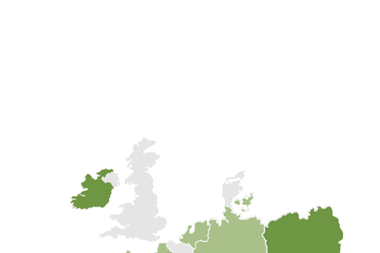
London has slipped to second in Investment Management’s annual European Regional Growth Index (E-REGI) following the country’s Brexit vote in June.
The uncertainty surrounding the UK’s future trade relationship with the EU is dampening economic prospects in the country, the firm said – even though London and the rest of the South East remain strong in a European context thanks to a diverse economy and high human capital.
Manchester and Birmingham fell the most in the rankings, as the economic uncertainty created by a looming Brexit could hamper corporate-hiring decisions in these cities, it said.
The index ranks Europe’s Top 100 cities based on their medium-term growth potential.
Recent political events are beginning to affect the attractiveness of Europe’s major cities as investment destinations.
Post-EU-referendum growth revisions in the UK have led to London’s losing its top spot to Paris, a place it held for four consecutive years.
The French capital is gaining momentum, with the country’s labour force more competitive and improved employment prospects.
The German cities of Munich, Berlin and Hamburg are also part of the 20 most-improved cities in the 2016 index.
LaSalle said the index included a component for human capital in a β€œknowledge-based economyβ€.
The component includes skilled population, creativity, venture capital and research and development.
In the UK, the inclusion of this component has helped not only London but also Bristol, Edinburgh and Manchester to maintain strong positions.
Mahdi Mokrane, LaSalle Investment Management’s European head of research and strategy, said the key drivers behind the index rankings this year were human capital and political decision-making.
β€œIn a knowledge-based economy, human capital, more than physical capital, plays a key role in creating economic value for investors and businesses alike,β€ he said.
β€œStrong human capital creates a virtuous circle, leading to greater productivity growth and stronger overall economic performance, which leads to higher rents and prices, which in turn creates greater human capital.β€
Mokrane said political decisions – rather than just the macro economy – had changed the outlook for many cities this year.
β€œInvestors are questioning the economic future of markets where economic uncertainty prevails,β€ he said.
β€œOn the other hand, we are also seeing politicians do not always receive the credit for policy decisions that strengthen their economic base.β€