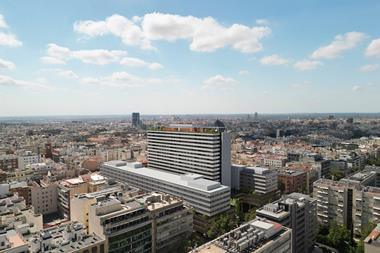


Adolfo Ramirez-Escudero, who was appointed the new managing director of CBRE Spain in early August, talks to PropertyEU about current trends in the Spanish real estate market.
Adolfo Ramirez-Escudero, who was appointed the new managing director of CBRE Spain in early August, talks to PropertyEU about current trends in the Spanish real estate market.
Ramirez-Escudero joined CBRE in 1994 as part of the London capital markets team, transferring to the Madrid office in 1996. During his career, he has worked with a range of domestic and international occupier, investor and developer clients. He has led the Spanish capital markets business and been a member of the country’s management team since 2005.
Ramirez-Escudero succeeds Eduardo Fernández-Cuesta, who has been with CBRE for 25 years and led CBRE Spain for 15 years.
PropertyEU: What will be your main priorities in your new role as managing director of CBRE Spain?
Ramirez-Escudero: My main priority is to consolidate and expand CBRE's strong position in the market, where we have been active since 1973. Although the sector in Spain has been adjusting to the more challenging economy we find there are many ways to continue to expand. We are focusing on our growing market share thanks to the consolidation of the market. Additionally there are new emerging segments such as sustainability services, as well as NPL and REO servicing. We already have a Chinese desk, which has been operating for over a year, taking care of Chinese occupiers, lenders and investors, and we are also working to offer an improved range of workspace solutions for corporate users.
PropertyEU: How has CBRE's business in Spain performed so far this year?
Ramirez-Escudero: We are really satisfied with the way we have weathered the most difficult episodes of the crisis. Our size and strategy of diversification has allowed us to maintain profitability, even though we have had to adapt our service mix to the new market situation. Asset management and property management services now represent a larger portion of our revenues, together with the consultancy and valuation business.
In 2013 we were awarded a mandate to coordinate the valuation of all the assets owned by the Spanish bad bank Sareb, in the largest single company valuation in the history of the market. We have also been able to triple our business in retail management in the last three years. Meanwhile our transactional activity continues, especially in the last few months. We have advised on a big share of the deals that have been closed so far this year and we also managed to go abroad with our clients and advise them in foreign markets with the help of our international team. A recent example of this is the sale of Tour Adria at La Défense.
PropertyEU: What are your ambitions/targets for the future?
Ramirez-Escudero: We are very excited about the business prospects in Spain in both the short and medium term. We definitely have an agenda for growth and our platform is very attractive for new talents. The high unemployment in Spain offers an incredible selection of very bright professionals eager to be part of a solid player. We are also ready to look selectively into acquisitions that complement our current offering to serve our clients.
PropertyEU: The investment market in Spain seems to be on its way to recovery. What do you see as the main trends shaping the industry at the moment?
Ramirez-Escudero: Clearly in 2013 there is a different attitude from investors compared to the previous year. We no longer hear about the eurozone collapse or about a major macro crisis for Spain: people are beginning to talk about assets and real estate again and they are prepared to underwrite investments. Of course lending is still the main bottleneck but this situation also represents an opportunity for cash-rich investors and alternative lenders, an area poised to grow in Spain.
We have had a very hot summer with regard to real estate activity and our view is that the autumn will also be busy. In the last three months we have seen over €700 mln worth of transactions being signed, indicating a strong uptick in activity. Players such as Blackstone, HIG, Varde, Autonomy, and AXA Real Estate are dominating the scene.
In terms of sectors, retail offers good value, even if consumption remains fragile, because it offers dominant assets at attractive values. Prime office rents in Madrid are at a 10-year low. On the financing front, Spanish lenders are quite cautious with only the largest banks open for business and very selectively. However, we are seeing some foreign banks becoming more active, especially German lenders which have a strong position given their particularly low funding costs. We also expect to see a larger role played by alternative lenders such as debt funds and insurance and pension fund asset managers in the future.
PropertyEU: The banking sector has long been at the centre of the property industry in Spain, with banks taking over a large part of the problem assets from the listed sector. What role are they playing at the moment?
Ramirez-Escudero: The banks in Spain have made an impressive effort and, in my view, the hard part is behind them. Their property services businesses are offering a great opportunity for spin-offs, and many have already been sold to private equity or services companies. Clearly we also need to see the normalization of lending activity which will mainly come from international lenders. Many of the new debt funds raised in Europe - over €3 bn in the last six months - will start progressively looking into Spain after having gained exposure to more mature and competitive markets such as France, Germany or UK.
PropertyEU: How do you see the market developing in the future?
Ramirez-Escudero: I foresee that investment will continue to pick up in the coming months. Market fundamentals have yet to show strength but the investment market - especially yields and volumes - always works in advance of evidence of fundamentals.
Once the Spanish economy starts to grow more solidly, probably in Q2 2014, we will see that rents for the best products, especially modern offices within Madrid's M30 ring road, will start to rise, also considering that there has been virtually no development in the last four years. We will see more sales of NPL portfolios and REOs, similar to what happened in Ireland with Nama, but probably characterised by lower volumes. We will also likely see the launch of new Socimi vehicles (the Spanish REIT) as well as FABs (a special low-tax vehicle introduced to encourage international institutional investors) while the listed companies will continue to sell their assets outside Spain or will merge into larger platforms.